The Econocracy: The Perils of Leaving Economics to the Experts (Manchester Capitalism MUP) by Joe Earle & Cahal Moral & Zach Ward-Perkins
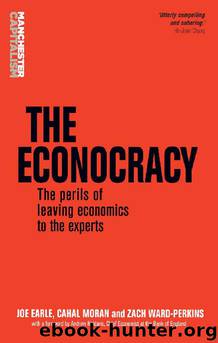
Author:Joe Earle & Cahal Moral & Zach Ward-Perkins [Earle, Joe]
Language: eng
Format: epub
Publisher: Manchester University Press
Published: 2016-11-03T02:00:00+00:00
Chapter 5
Rediscovering liberal education
Economics as a pluralist, liberal education
[The purpose of universities] is not to make skilful lawyers, or physicians, or engineers, but capable and cultivated human beings.
John Stuart Mill, 18671
The School again is not a place of technical education fitting you for one and only one profession. It makes you better for every occupation, it does help you get on in life … But you will lose most of the value of the School if you regard it solely as a means of getting on in life. Regard it as a means of learning, to advance science and civilization.
William Beveridge, 19242
These quotes from two of Britain’s most famous economists set out an approach to education that contrasts radically with economics education today. It is an approach called ‘liberal education’ and in this chapter we argue that it provides a set of principles that can be used to reform economics degrees. In this section we introduce the idea of liberal education and in the next we explore the history and state of the English higher education (HE) system since 1945 and show how far liberal principles have been neglected. Finally, we set out some ways in which these principles can be used to reform economics within our current system.
The roots of liberal education are as old as Western civilisation itself. In Ancient Greece the philosopher Socrates developed a method of teaching now called the ‘Socratic dialogue’ in which he challenged his opponents to develop and defend their opinions and beliefs using reason and logic. Socratic pedagogy emphasised the role of reason in education, the importance of challenging authority and accepted thought, and the importance of self-criticism. This approach has important implications for education today. It tells us that the ability to develop independent, reasoned judgements while being critical of one’s own traditions and beliefs is a prerequisite of thinking for oneself and ultimately being a free individual.
Socrates’ approach was radical because it implied that social norms were changeable, not fixed – and that ultimately it is our collective responsibility to examine, question and challenge these norms if necessary.3 The next generation of economic experts must be made aware that there are different ways of thinking about the economy so that they can engage critically with theories that are currently handed down to them unquestioningly.
What a liberal education has meant in practice in British universities has varied greatly over time and, as a consequence, the concept has many different and even contradictory meanings.4 Liberal educational principles are shaped by their wider social and political contexts. They can be used to both defend the social status quo by giving elites a shared sense of identity as in eighteenth-century Britain, or to challenge and question accepted norms as Socrates did in Greece.5 In our view, both the transmission of civilisation, culture and common standards of citizenship as well as the encouragement of original, critical thinking are important parts of any educational philosophy. Finding ways to do both is one of the great challenges of any form of education.
Download
This site does not store any files on its server. We only index and link to content provided by other sites. Please contact the content providers to delete copyright contents if any and email us, we'll remove relevant links or contents immediately.
| Anthropology | Archaeology |
| Philosophy | Politics & Government |
| Social Sciences | Sociology |
| Women's Studies |
The Secret History by Donna Tartt(19102)
The Social Justice Warrior Handbook by Lisa De Pasquale(12197)
Thirteen Reasons Why by Jay Asher(8918)
This Is How You Lose Her by Junot Diaz(6894)
Weapons of Math Destruction by Cathy O'Neil(6284)
Zero to One by Peter Thiel(5807)
Beartown by Fredrik Backman(5766)
The Myth of the Strong Leader by Archie Brown(5512)
The Fire Next Time by James Baldwin(5454)
How Democracies Die by Steven Levitsky & Daniel Ziblatt(5224)
Promise Me, Dad by Joe Biden(5157)
Stone's Rules by Roger Stone(5090)
A Higher Loyalty: Truth, Lies, and Leadership by James Comey(4966)
100 Deadly Skills by Clint Emerson(4931)
Rise and Kill First by Ronen Bergman(4797)
Secrecy World by Jake Bernstein(4756)
The David Icke Guide to the Global Conspiracy (and how to end it) by David Icke(4722)
The Farm by Tom Rob Smith(4517)
The Doomsday Machine by Daniel Ellsberg(4493)
